Projects Realized with bioMECI technology
David Rosenboom
Ho Hay Banda Concert – Montreal 3 December 2025
Featuring Portable Gold and Philosophers’ Stones (Deviant Resonances)(full program available here)
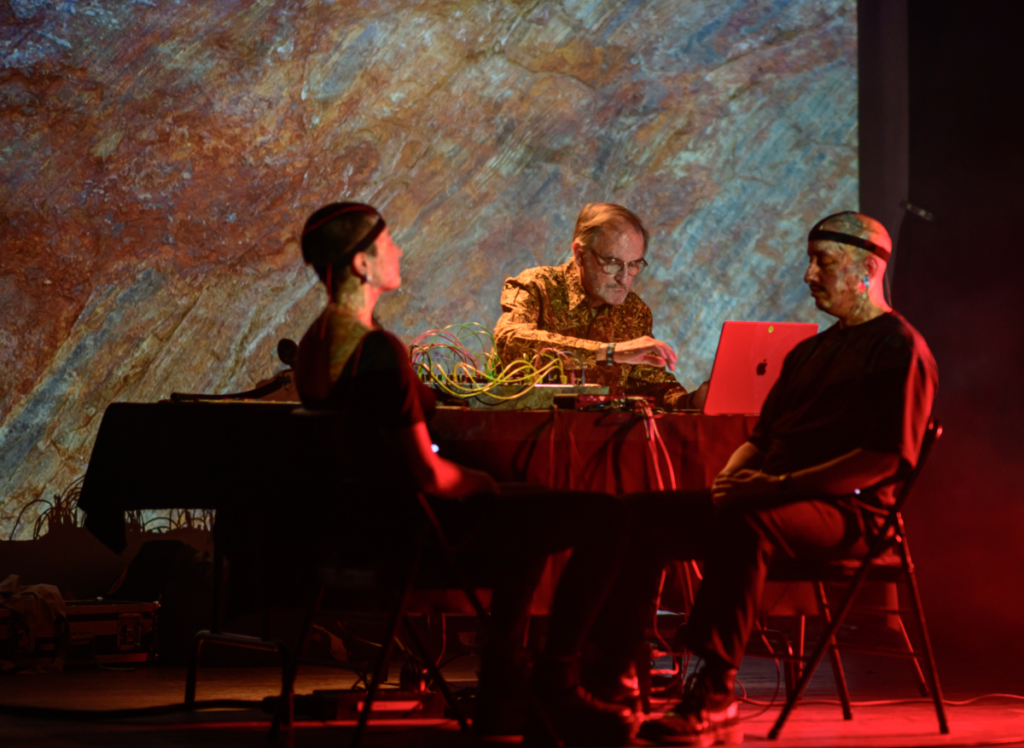
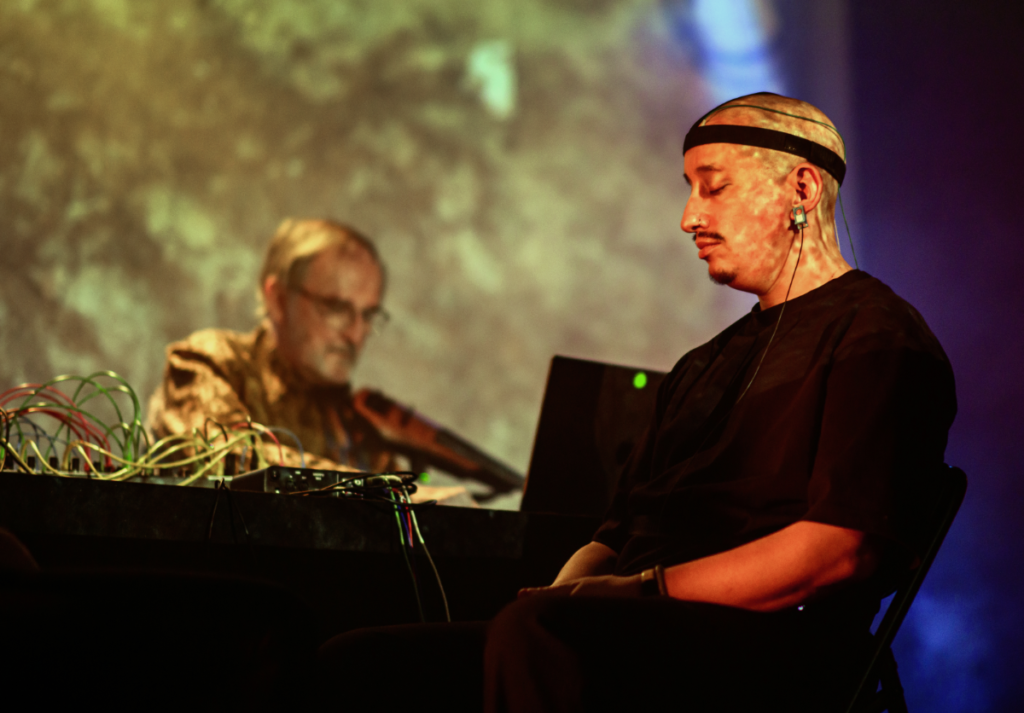
On December 3rd, 2025, the No Hay Banda organization produced a concert of David Rosenboom’s music at La Sala Rossa in Montréal, Québec, Canada that included his neurocybernetic work, Portable Gold and Philosophers’ Stones (Deviant Resonances). In it, two copies of THE SOURCE from bioMECI, were used to capture brain signals from two biofeedback performers, artist Juliette Duhé and sound artist Martin Rodiquez, and interface them with Rosenboom’s software. Rosenboom joined them in a live biomusic trio by adding electronics and electric violin. The event was documented in photos by Ben Jackson.
more…
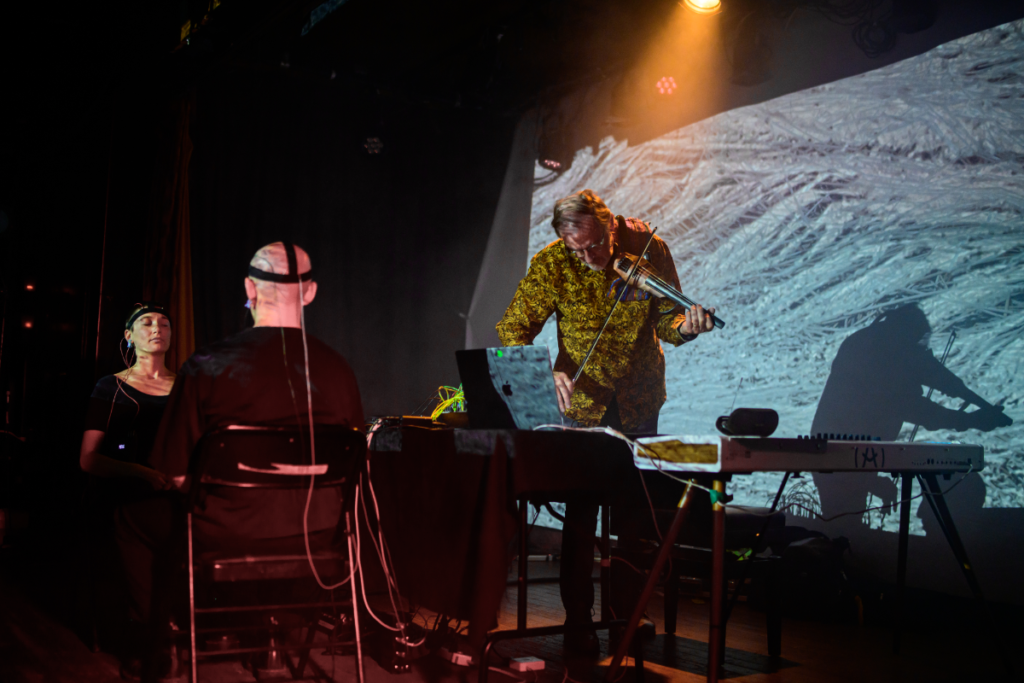
In addition to being a composition, this work is also a neurocybernetic instrument, with which a large domain of organized sonic landscapes may be traversed, always anew. It’s also about listening as performance. To materialize that idea, specific features that can be sensed and analyzed in electrical signals emanating from the brains of two active imaginative, listening performers linked to procedures for generating an electronic sound tapestry. A third performer calibrates a computer system to best follow varying degrees of coherency among particular smooth waves found in the listening performers’ EEGs, which can be associated with various states of consciousness, and which they may learn to influence. In addition, the system detects both individual and synchronous changes in the EEGs that are typically associated with how the listeners’ attention may be shifting among features in the sonic landscape. The analysis and synthesis system adapts and responds to these features in specific ways. The performers listen creatively, noting how their attention moves and any ability to influence the sounds. The computer-electronics performer also interacts with them musically in a live, trio performance. In this performance, THE SOURCE’s performed as reliable and stable biosignal acquisition devices.
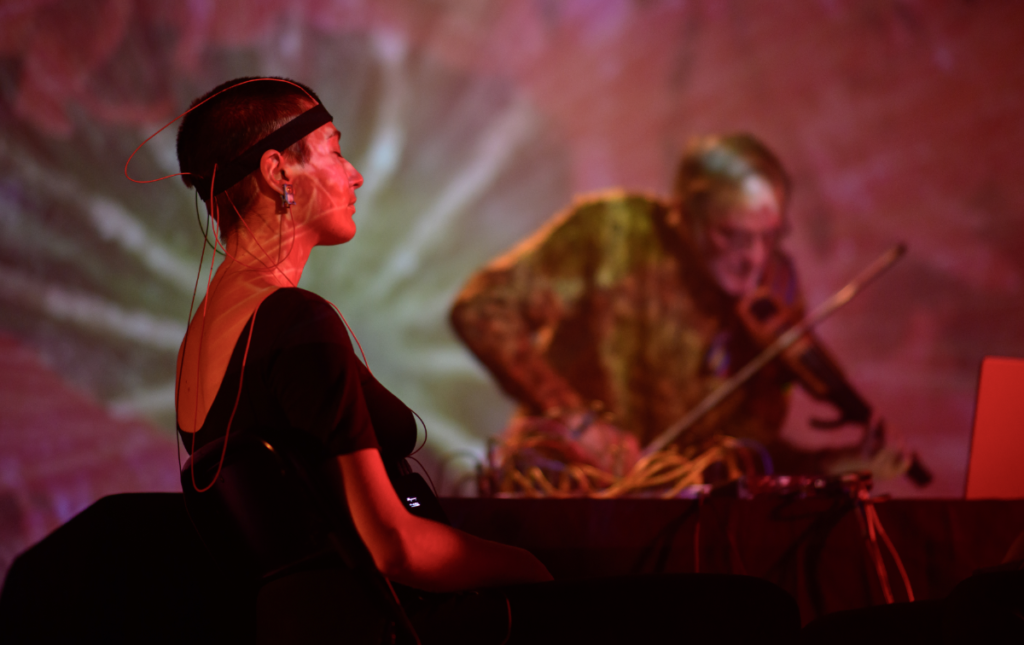
This work has emerged from many years investigating how we pay attention to margins of uncertainty near the boundaries of recognizable resonant elements. It also explores how unpredictable transient events may either reinforce or interrupt emerging orders among resonant patterns. All this is carried out within the framework of how we might fuse brainwave patterns and musical forms. In the context of performances like this one, our intentions are artistic and inclusive, melding products of scientific investigation and technology with aesthetic inquiries and speculations about the nature of human awareness and our ability to describe what we perceive as self and universe.
DR 3 January 2026
the body in\verse
Alan Macy, Mark-David Hosale, Alysia Michelle James
Currents 2021 (Virtual) Livestream multimedia performance. June 19th, 2021
The body in\verse is an online, interactive performance that combines biophysical sensing, emotive state sonification and visualization, and generative poetry to create the scene.
more…
The performance provides a deep dive from the world outside of ourselves, that is dissociated by mediated technology, into the interoceptive abyss of our emotive sea. A biophysical sensing system measures the emotional affect of the performer, and then uses that data to drive the sound, abstract imagery, and a generative poetry algorithm. Emotional affect of the performer is assessed through arousal and valence measures derived from correlation of the performer’s heart rate and heart rate variability. An algorithm generates poetry using conversations that take place with the audience as source material. The poetry source material is then algorithmically organized according to its sentiment (positive to negative), and mapped to the emotional affect of the performer driven by the emotional affect assessment from her biophysical measures.
HeartBeatDress (2021)
Anouk Wipprecht
PACIS Pak was used in making: HeartBeatDress – Anouk Wipprecht x Swarovski || ‘Wearable Emotions’ from Anouk Wipprecht on Vimeo.
In collaboration with a leading crystal manufacturer, Dutch FashionTech Designer Anouk Wipprecht releases her new 3D printed ‘HeartBeatDress’ – a dress that records and broadcasts something very ‘intimate’ to you as a provocation to be true to your feelings.
more…
“At the dawn of this Modern Age, technology has given us the flexibility to investigate endless opportunities with electronics that have become smaller and smaller. Over the past 20 years, I’ve been connecting our bodies to electronics and integrate this through robotic fashion design. What does it mean when we can connect technological-expressive garments to our bodies, body signals, and even emotions?” the designer questions.
Reaching farther than curiosity, Dutch designer Anouk Wipprecht’s creations combine haute couture aesthetics with digital technology that examines the behavioral, neurological, and emotional states through visceral interaction. With a forward-thinking vision, she believes high-tech fashion is the key to a deeper understanding of how we process our emotions and their effects on our minds and bodies.
One of her new deviously disruptive designs is a piece she’s developed with crystal-maker Swarovski that uses built-in sensors, robotics, sound and light to respond in time with the wearer’s heartbeat. (http://www.anoukwipprecht.nl/)
SensualMap 2.0 Meets THE SOURCE
Azi Tadayoni
Masters in Sound and Music Computing (2025), Aalborg University, Denmark SensualMap 2.0 Meets THE SOURCE is an instrument designed and build to support the notion of mapping as a deeply sensual process. In this project Azi Tadayoni has worked with their interest and education in textiles and engineering as a tribute to fashions role in electronic music culture, intersecting with their own artistry.
more…
As an artist and researcher they have made a contribution to the TIME (Textile Interface for Musical Expression) community through a project that focuses on self-expression, embodiment and identity. They use fashion, not only as a mark of identity and expression, but as a dimension that gives a certain quality to how you feel when you interact with other people. The pattern of the wearable is for examples taken from a dress given to them by a colleague in the electronic music scene, when they decided to move countries. Gold studs attached to black buttons are integrated into the circuit, each mapped to trigger custom samples when touched. Their placement around the heart area personalizes the instrument, creating a tactile and sensorial experience for the performer. Inspired by the hand on heart meditation and musical expression as a tool for storytelling and resistance, the instrument seeks to challenge the notion of instruments existing as external units, and curate an opportunity to place a hand on the heart while practicing, in an industry that can be overwhelming. With the gesture incorporated in the process, the interaction guides towards bodily sensory sensation while creating an intimate feedback loop involving sound and ECG-data.
The instrument are created with THE SOURCE, and through electrodes, the system captures the performer’s heartbeat, translating their BPM data into a flanger effect that filters and modulates the sound.
SensualMap 2.0 meets THE SOURCE is a dialogue between body and sound, where identity, body and sound become a continuous extension of each other.
Azi Tadayoni extends gratitude to professor Dan Overholt for supervising the project and to Hamid Tadayoni for the drum sample included in the visual presentation.
Kaleidoscope, 2025
Xuan Han
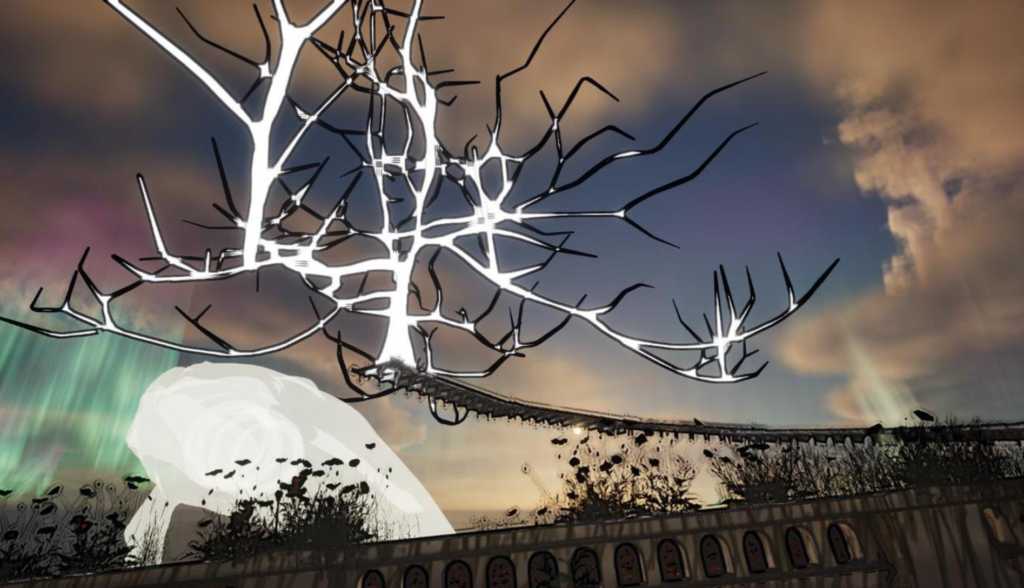
Masters in Digital Media (2025), York University, Toronto Kaleidoscope is an experimental game that investigates how visual and auditory stimuli affect players’ emotional states through real-time physiological feedback
more…
Unlike conventional games where emotional tone is pre-scripted, Kaleidoscope invites players to actively regulate their emotions as part of the gameplay. Using THE SOURCE by bioMECI for heart-rate monitoring, the game collects players’ real-time heart rate variability (HRV) data and translates it into adaptive audiovisual responses. When a player’s heart rate rises, the environment dynamically darkens, sounds grow tense, and visuals distort—immersing the player in a responsive emotional loop. To restore calm, the player must consciously manage breathing and attention, turning emotional regulation into both a narrative and mechanical challenge.
The game integrates color psychology, sound design, and multimodal interaction theory to analyze how combinations of color, light, and music shape mood and engagement. Each of its three acts—Uncertainty, Exploration, and Release—uses shifting light and sound to evoke emotional transformation. The visual style combines 3D environments with painterly 2D rendering, producing a surreal, dreamlike aesthetic that reinforces the theme of introspection. Empirical testing was conducted with five participants aged 20–30, combining heart-rate data with Self-Assessment Manikin (SAM) evaluations before and after gameplay. Results showed a general increase in emotional valence and arousal, suggesting heightened engagement and emotional uplift. Interestingly, many players instinctively paused to stabilize their heart rate when visual and auditory tension increased, demonstrating the effectiveness of the biofeedback loop as a reflective emotional tool.
Through this experiment, Kaleidoscope demonstrates how bio-responsive design can merge psychology, physiology, and aesthetics into a cohesive interactive experience. The project highlights new possibilities for games as tools for emotional awareness, self-regulation, and embodied storytelling.
The Death and Existential Virtual Environment (DEVE), 2023
Kwame Kyei-Boateng
Masters in Digital Media (2023), York University, Toronto Death reflection is the deliberate contemplation and contextualization of one’s mortality, and is often explored in traditional media and art forms, such as novels, theatre, and film; but how can new media be used to encourage death reflection? In the early days of the COVID-19 pandemic recovery, it became ever more clear how necessary it was that we found ways of healing our minds as much as we did our bodies. With the drastic evolution of Al technology and a growing revolution in VR technology, there are greater means of aiding in this healing process through computational art, just like the traditional arts have always done.
more…
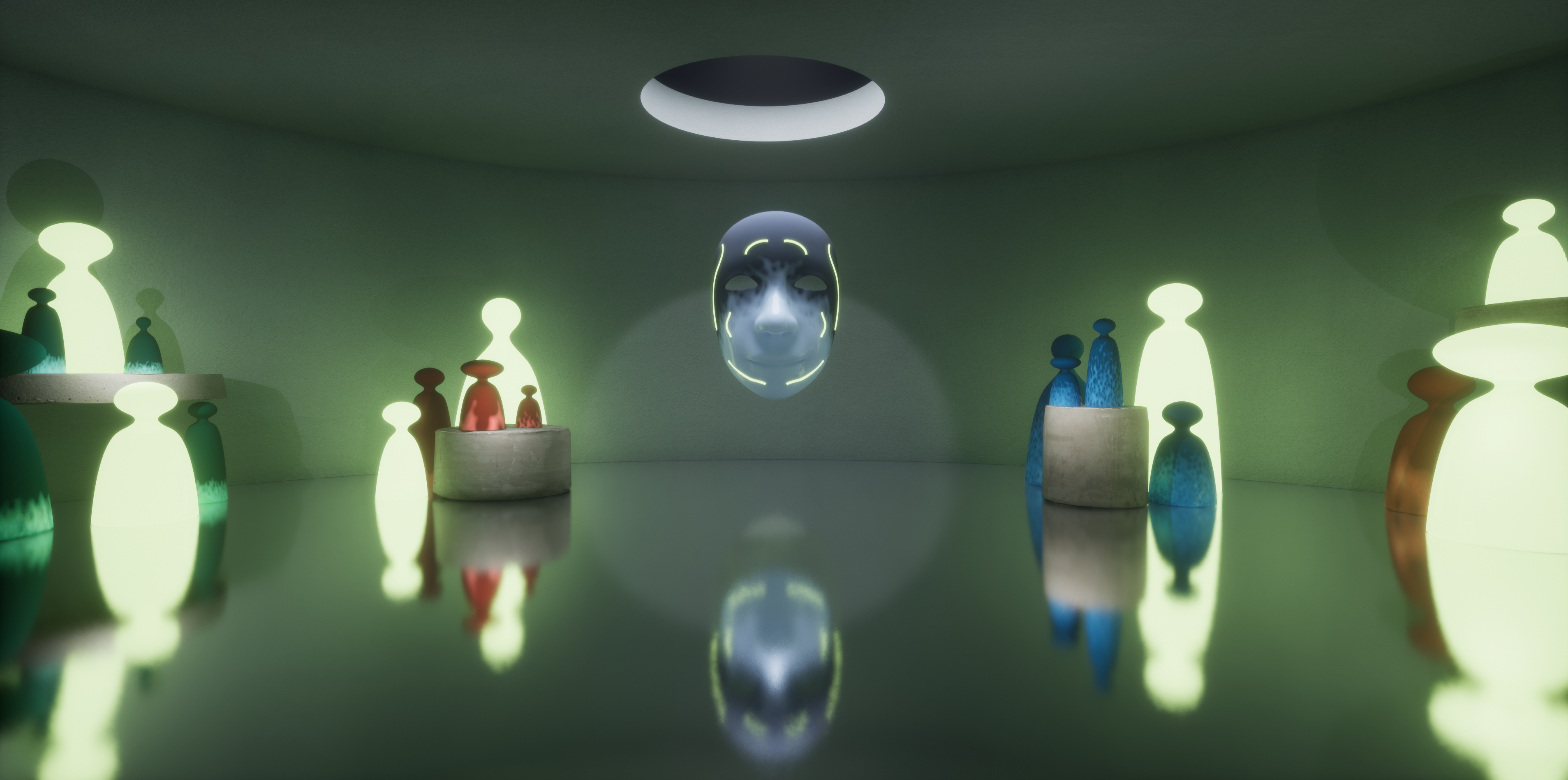
The Death and Existential Virtual Environment (DEVE), is a project that aims to foster death reflection and existential contemplation. The project invites a participant to communicate with a virtual agent about mortality and existence within a 3D virtual environment influenced by the participant’s heart rate data. DEVE is an exploration of psychological well-being through new media arts and human-computer interaction. DEVE explores the boundary between the physical and the virtual, materialising these shifting boundaries to help create a hybridised environment in which the space reacts to the body. Using an observer-first approach, the participant’s perspective becomes the focus of the experience, rather than an afterthought, immersing them in the narrative of the installation.
Siren
#MTF Music Tech Fest, Aviero 2021
Siren is a ritualized performance inspired by the Aveiro para-hydromorphic Regosal – the constantly changing boundary between land and water. Breathing, voluntary and involuntary muscle movements and dual heartbeats compose the sound. The performance is accompanied by an interactive video-art piece edited from a film taken from a site-specific performance at the Aveiro wetlands.
more…
Anya Yermakova (performance, improvisation and composition)
Alexandra Antopoulou (cinematography video art, costume and ritual, spoken word)
Scott Beibin (data collection assistance)
Konstantinos Damianikis (video art and design)
Gonçalo Guiomar (vocals)
Mark-David Hosale (sound design and live electronic composition)
Cindy Macy (breathing and spoken word)
Alan Macy (interactive bio-sensing and sound design)
Mónica Pedro (fish skin harvesting and processing and location scouting)
Diana Vieira (poetry and environmental science)
Débora Umbelino (spoken word)

Hand to Heart
Alan Macy
The base PACIS system was built around the Hand to Heart
(https://alanmacy.com/project/hand-to-heart/).
By transporting a “mimic” of the heart, outside of a participant’s body, another person can touch this very central part of the participant’s nature. In the case of “Hand to Heart”, the embodiment principle is mediated by the senses of sight, sound and touch, so the recipient participant is gifted an intimate, physical connection to the source participant.
more…
The “Hand to Heart” project establishes a vulnerability for the participants. The two participants, source and recipient, establish a direct link between their sensory frameworks.
The source participant develops a visceral awareness of the environment’s effect upon their own physiological state and then, by extension, their conscious state.
The idea of the heart “mimic” is central to this art project because the heart has deep and abiding connections to the emotional and motivational foundational states that support judgement.
The external heart “mimic” is solidly based in robust technology. The technology amplifies the electrocardiogram (ECG) of the source participant by a rough factor of 2000. This amplified data drives light sources, audio and tactile transducers inside the heart “mimic”. The ECG is representative of the contraction of cardiac muscle, so this same contraction signal drives the activation behavior of the heart “mimic”. The link between the real heart, and the heart “mimic”, is essentially instantaneous and fully analog.